Tuesday, July 30, 2019
Why?
Boats get a grip on people. Though I am one of them don’t ask me why. It has been so since I was a kid. And despite being prone to seasickness and terror during some of the worse weather Lake Michigan can throw at a small boat, my obsession has not faded.
I have like minded friends with whom I constantly chatter about boats but never does this aspect of boating come up. Many of us have blogs or Facebook sites. These venues do not usually lend themselves to psychobabble, so the topic is not discussed.
This year’s (2019) cruising is ending early. There are health issues that should not be delayed but believe me, when to end the cruise was given much thought. The common refrain being, “Well, it will only be a four . . . . three . . . . two months delay. What difference can that make?”
I should and do know better, so two months was decided on and here we are anchored in thirty feet of water at high tide with two days remaining.
There is a warmish south wind blowing over the North Haven bluffs. The sky is clear and a kind of blue grey. A classic Herreshoff 12 ½ sailboat is tacking back and forth across the harbor. The occasional gust surprises and it points into the wind to spill the air captured in its sails. This is an ideal spot.
We both had luxuriant hot showers by Carrie Rose’s standards. Soon the water will be drained and we might as well waste it on ourselves.
There are only a few sounds. The drum like dinghy plops in the short chop that streams by the boat. On shore, children exclaim their joy. A small plane appears over the treetops buzzing into the wind as it slowly climbs. The flag rustles.
See, this is what happens. I began with a philosophical purpose and now I have devolved into listening to a flag rustle. I mean what the hell else is a flag supposed to do!
Augusta, Maine
Pulpit Harbor
Osprey Landing Its Catch
There is a Hinckley masthead sloop off our port side. It is probably forty feet long and though its lines are sleek, it bobs in the light swell like an eider duck. Unlike modern sailboats that fill the water up with their entire length, this beauty has long overhangs: maybe not as efficient but striking.
These boat are the pedigree of Maine. The market has moved on to other things, so now Hinckley produces a classic series of state of the art powerboats. They have managed to keep their boats distinctive. The owners of these crafts treat them like fine watches. I have never seen one that was not perfect.
There are many fine designs represented in Pulpit Harbor. There is the resident mix of working and pleasure craft, and then there are the transients, like us, that come in here to fantasize about being part of this world.
It is a small subculture of summer people and natives, and I suppose us cruising folk that show up for a few days a year to anchor in the mud are part of the mix. The harbor is often the first or last stops for the windjammer fleet sailing out of the towns on West Penobscot Bay.
Carrie Rose tends to get into harbors early and that means she is able to pick her spot without the interference of other boats. The chart plotter has several anchor icons representing where she has placed her anchor before. This makes the process of anchoring less stressful. The correct decision has already been made, so now there is no need to fret.
Glide to the mark, let go the anchor, set it with a few reverse thrusts, and then settle in, look around, and wonder after fifty years of dreaming how did we end up here . . . .
Augusta, Maine
There is a Hinckley masthead sloop off our port side. It is probably forty feet long and though its lines are sleek, it bobs in the light swell like an eider duck. Unlike modern sailboats that fill the water up with their entire length, this beauty has long overhangs: maybe not as efficient but striking.
These boat are the pedigree of Maine. The market has moved on to other things, so now Hinckley produces a classic series of state of the art powerboats. They have managed to keep their boats distinctive. The owners of these crafts treat them like fine watches. I have never seen one that was not perfect.
There are many fine designs represented in Pulpit Harbor. There is the resident mix of working and pleasure craft, and then there are the transients, like us, that come in here to fantasize about being part of this world.
It is a small subculture of summer people and natives, and I suppose us cruising folk that show up for a few days a year to anchor in the mud are part of the mix. The harbor is often the first or last stops for the windjammer fleet sailing out of the towns on West Penobscot Bay.
Carrie Rose tends to get into harbors early and that means she is able to pick her spot without the interference of other boats. The chart plotter has several anchor icons representing where she has placed her anchor before. This makes the process of anchoring less stressful. The correct decision has already been made, so now there is no need to fret.
Glide to the mark, let go the anchor, set it with a few reverse thrusts, and then settle in, look around, and wonder after fifty years of dreaming how did we end up here . . . .
Augusta, Maine
Thursday, July 25, 2019
Floating
Maine is a magical place.
The land comes and goes, as do schooners,
Enveloped in fog, drenched in rain, and on occasion,
In gloriously warm sun.
Seal noses pop up from the depths.
Osprey fly off the tops of towering conifers to hunt in open bays.
Fish jump into circular waves that interact
And dissolve into chaos.
Unobtrusive lobster boats appear to do their circular jig
And depart in a cloud of black exhaust.
Tides and currents reinforce the natural world.
There are raindrops on the water.
There are campfires on the land.
There are clouds of mosquitos at the screens
Trying to bludgeon a way into warm mammalian skin and blood.
Beethoven’s first Piano Concerto sounds in the foreground:
Pastoral and aggressive . . . .
This moment floating off West Penobscot Bay.
Warren Island State Park, Maine
Antsy
Morning comes early in Maine. By 5 AM with the sun barely over the treetops, it is bright. The air is clear, barely anything exist here to pollute it. The sun’s rays travel unimpeded and in the process fill Carrie Rose’s batteries with electrons.
It is cloudy this morning. Not rain threatening cloudy but high broken clouds that are slowly moving to the NE. The band of blue sky over Camden will soon be over us.
At 9 AM, I am already four hours into the day and getting antsy. The launch, which will transport us off the water and on to the mainland has been ferrying boaters since 8 o’clock. It occasionally passes by and throws a wake our way.
There are racing sailboats crisscrossing the harbor, sailboarders doing whatever they do, and there are departing cruisers leaving the two red markers, which delineate the rock free passage, to their port.
The sun appears and with a flash, the harbor is full of rusty reds, dark greens, blacks and whites, and here and there, blues. The water is a deep violet blue speckled with dark grey. Polished metal glints in contrast to deeply varnished wood. And throughout these observations, I am thinking it is time to get going . . . . but going where?
With the sun, the pilothouse goes from the 60’s to the 70’s and it is time to lose the flannel shirt and socks. It is summer after all even if we are in Maine where the North Atlantic creeps in with every high tide.
Since I awoke, the barometer has risen two points to 30.00 mmHg. So maybe, the high pressure is pressuring me to get the day going even if in the end it is going nowhere.
Camden, Maine
Stinky
Some may feel that two people, especially if married for decades, might find a 32 foot motor yacht (no matter how well designed) confining. If a months long cruise, many times without the ability for onshore distractions, is added to the equation, then the argument for incompatibility grows stronger.
From me you will find no argument with the above. These tendencies need to be anticipated, discussed, and through negotiations and the occasional mediation, overcome. The fact that Carrie Rose is able to swing at anchor in Maine is a testament to the fact that it can be accomplished.
There are times when continued cohabitation is challenged. It is not like these are planned. They evolve from a series of unforeseen circumstances. This recently occurred on Carrie Rose.
Think of the boat as a high end RV with a propeller. There are numerous mechanical systems and as mechanical systems are prone to do, despite conscientious maintenance, they fail. There are (to borrow a word from past committee work) multiple root causes. In today’s crasser world the phrase that comes to mind is, shit happens. And that aphorism is especially true in this instance.
In the confines of the Great Lakes, it is forbidden to pump black water or effluent or whatever else it is called, overboard. To be caught, as unlikely as that may be, would result in keelhauling by the United States Coast Guard. Most fresh water sailors disconnect the overflow plumbing. That way if ever boarded by the Coast Guard there is plausible deniability. Carrie Rose found herself in this state.
But in the state of Maine, as long as not in confined spaces, our poop may mingle with that of whales and seals and porpoises. But I get ahead of myself. Boats can be particularly stinking places. There are countless offending agents. And many of them lurk and mingle, in dark, humid, and airless crevices.
Engine oil, diesel fumes, antifreeze, molds and mildews, errant holding tank gases ferment with salt and fresh water; it is a potent mix. It is a mark of a true yachtsperson to be able to brag of a dry bilge. Despite Carrie Rose’s numerous virtues, a dry bilge is not one of them.
There have been moments when no offending agents exist in the nether world but faith intervenes and the process of hunting down the source or sources begins anew. This was recently the case.
I feel I must warn, like on the radio when a racy or violent program is about to be aired that the more sensitive listeners turn the volume down for the announced time span. This may be the time to look away from the page.
A decision was made that due to Maine’s lack of holding tank pump out facilities Carrie Rose should have a way to empty her own waste tank. Of course, this would only be done outside the three mile limit of the United States territorial waters. It involved the installation of various new hoses, a Y-valve, and a device worthy of a starring role in a horror movie called a macerator pump.
I considered the task doable and even bought some of the parts, but as the winter progressed the thought of wedging myself into the confined and smelly place brought me to my senses. Thus, it was decided to let the mechanic at Carrie Rose’s boatyard tackle the installation. It proved to be a smart move as I had underestimated the complexity of the connections.
The process was completed with my constant cheerleading. Carrie Rose was now in the water and I was itching to try the new system out. There was only one caveat it needs to be full. Due to our finely honed and frugal head usage, this could require a month. To circumvent the delay I suggested we forgo the usual precaution against a fetid head and flush with salt water.
Understand that salt water is not a benign substance. It is corrosive. It is packed with the denizens, albeit tiny, of the deep sea. And there may be remnants of Maine’s ten common seaweeds. To seal these into an airless tank along with other unmentionables, to use a worn out cliché, is a recipe for disaster.
Now I might have got away with the experiment had I not forgotten that the holding tank vent filter had been done away with several years ago. The instructions state yearly replacement but at a cost of eighty dollars, it stayed in place for a half a decade. When it finally blocked the clear flow of air, I dispensed with it services.
The experiment went well for a few days. It was cold and there had been minimal intake but that was to change. Canada and Maine decided to break high temperature records and we had inhabited the boat for a week to ten days. Without warning, flushing the head enveloped the usually pristine Carrie Rose in a cloud of noxious fumes.
Charlotte, whose nose is not typically that sensitive, called out in fright. I, of course tried to minimize the severity of the situation we found ourselves in. We began to warn each other when the head needed to be used. And though there is no place to run and no place to hide, Charlotte would station herself on the aft deck in anticipation of the oncoming stench.
Our usual docile relationship turned contentious: mine with futile denials of being the causative agent of this disaster and Charlotte’s with demands for an immediate fix. Both were implausible. I immediately tried by phone, Internet, and on foot to procure another filter. All my efforts were stymied.
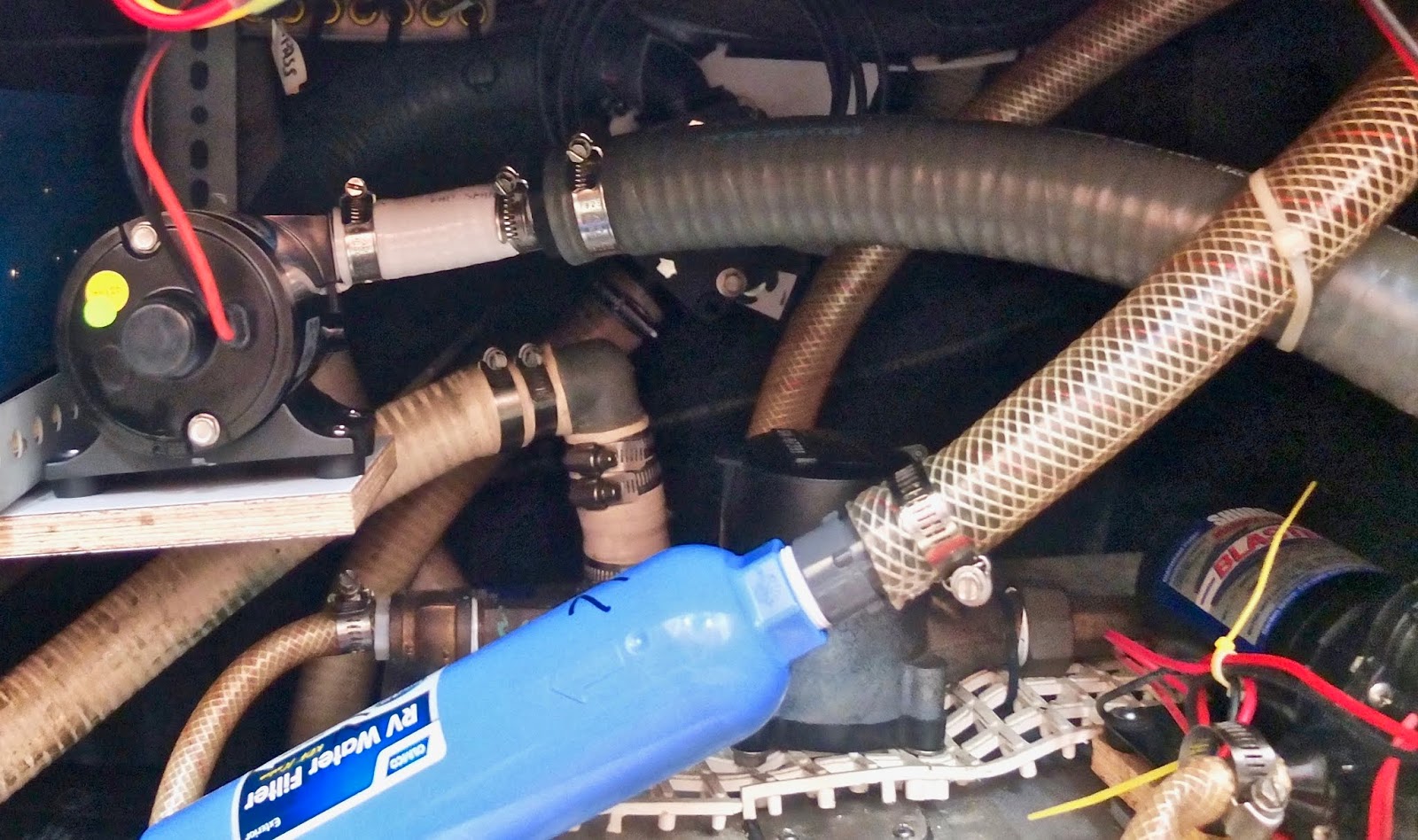
Out of frustration, I confided in Dave of the famously, on many coasts, pristine Sir Tugley Blue, our traveling companions. He had a solution, that if I could find the correct fittings, he thought it would work. It was a humble RV charcoal water filter. The charcoal provides the barrier from the stinky tank to the outside world.
I searched through my stash. It looked promising except for one adapter. By this time, the unhappy crew of Carrie Rose had made it to Belfast, Maine for the upbeat Celtic Music festival. Belfast is a thriving town with an old fashion hardware store, and a rare owner that knows where every piece of inventory, no matter how insignificant, lives.
I searched the unlabeled drawers and became dejected. Then I enlisted the help of a young sales assistant, who after taking one glance at the mess, mumbled that only the owner would know if the part exists. A stooped but smiling tall and lanky middle aged man appeared, and inquired as to what I needed: ¾ threaded to a one inch hose fitting adapter.
He hesitated for a second; his hand reached into the hidden depths of an outwardly random drawer and came out with the part. The rest was mere mechanics.
Within twenty minutes the part was installed, tested, and pronounced a success by the first mate. Life went back to normal but then I suppose if a normal life is what Carrie Rose’s inhabitants wanted they would not have left the bungalow on Talman Ave. nine summers ago.
Warren Island State Park, Maine
Tuesday, July 16, 2019
Windshield Time
Taking on fuel in Southwest Harbor, MDI
Sunset in Seal Bay, Vinalhaven, ME
Sir Tugley Blue in twilight blue
J.O. Brown, North Haven, ME
I practiced chiropractic in Mt. Prospect, IL during the 1980’s. One of my patients was a fortyish male who resembled Falstaff as portrayed by Orson Wells. He was a Bell Telephone technician. His back suffered from poor physical conditioning and from long bouts of what he called “windshield time”.
It was the coveted time spent driving from one assignment to the next. He would fondly describe listening to the radio while snacking on the junk food of the day. Though it didn’t help his back, he was content to erred towards the sedentary aspects of the job.
Out on the water, chugging along at seven or eight knots with no obstructions for miles ahead makes me think of my windshield time. And though the distances covered are trivial in terms of ocean sailing, I ask myself if I covet the passages or not.
In the Great Lakes, it was common to cruise for 50 to 90 nautical miles at a time, and to have no land in sight for much of the trip. Most of the time there was only the occasional 1000 foot freighter to contend with, and they stuck close to the shipping lanes.
Once out on the lake and away from the shore with its gaggle of fishing boats, the autopilot would be set, and the feet would be kicked up. An occasional glance out the window and at the radar was enough to assure a safe passage.
Piloting Carrie Rose up and down the east coast of Canada and the USA requires a bit more concentration. Here in Canada and Maine there is the constant presence of lobster buoys, and variations in tidal currents and sea levels. It calls for an odd combination of alertness, and for the loss of a better description, spacing out.
It is difficult to maintain constant awareness. Even when focused, other tasks need to be attended to. Before altering my attention, I scan the horizon, review the chart and course, note the engine gauges, and make sure the autopilot is engaged. It sounds like a lot to do but it only takes a few seconds.
Despite these precautions, more times then not, something will require an immediate response. Of course, it helps to have Charlotte’s eagle eye stationed in the pilothouse.
I wonder about the inevitable story after every accident involving a behemoth ship’s crash of there being no one at watch. These stories seem to me to be disingenuous. It may be that the crew and its leadership is incompetent, but it is difficult to imagine leaving a hundred million dollar vessel to fend for itself.
My original intent was to write about how windshield time plays with the mind. How hours and hours of starring out the window, no matter how concentrated, allows the mind to catch up with itself. To sort out, in all the neuronal crevasses, the connections, past and present, that needs to be eliminated or filed.
When on Carrie Rose for a while it is usual for distant faux pas to appear out of nowhere. I have accustomed myself to disregard them for there is no resident psychotherapist on board. Happier moments also via for time in the mind’s eye, and occasionally there is a struggle between the light and dark side. May the best memory win out!
I in the meantime will keep my eyes pealed for the slightest hint of trouble out the windshield . . . no matter the time.
North Haven, Maine
Friday, July 12, 2019
Eddies
The Bay of Fundy was never on the bucket list. Somehow, Carrie Rose ended up there through no fault of her own. The bay’s entrance is approached using the Grand Manan Channel, which is demarcated by the coast of Maine and Grand Manan Island. And as with most directions in Downeast Maine and New Brunswick, the path is more east than north.
The Bay of Fundy is noted for its extreme tidal ranges. Though Carrie Rose did not experience the full range, she was rising and lowering 25 feet twice per day. It is quite the striking visual to be surrounded by water and six hours later to be surrounded by land. The mud flats reach out and then recede in magnificently smelly glory.
The towns and anchorages within Passamaquoddy Bay were the destination. The bay is accessed two ways: one through the Quoddy and the Lubec Narrows (previously written about) and the other through Letete Passage, an opening amongst the archipelago of islands north of Deer Island. There are other ways but these are the most familiar.
As with the Lubec Narrows, the Letete Passage needs to be respected and the passage timed properly. On this transit, it was deemed that low slack tide was the best time, so to arrive there at 11:15 AM the anchor was raised in Digdequash Cove at 10:00 AM. It was a bit more then an hour at seven knots.
The water was alive with Canadian lobster fishermen finishing up a season of lobstering. Many lobster cages weighed down their stubby boats. They scurried from buoy to buoy doing the dance of the lobster boat: turn towards the buoy, bring it on the starboard side, grab it with the hooked pole, hook the line on the pulley and then onto the winch, bring it along side, open and empty it, bait it, drive a bit then throw the buoy in the water and let the cage slide off the back of the boat.
The boats swing around in a circle while this dance is taking place, and usually end up pointing in the same direction as when they first approached the buoy. Mesmerized by the process, I have to remember to look forward not to snag a buoy.
At the Letete Passage the whirling waters begin. The water becomes three dimensional as eddies wax and wane. Disrupted current creates a popular fishing venue for seals, birds, porpoises, and whales. Carrie Rose gets a few more RPM’s to help with directional stability and just to get through the maelstrom quicker.
Now out to the coast along Campobello Island, famous for Franklin and Eleanor’s summer estate. After visiting there I feel I could be on a first name basis with them or at least with Eleanor, and possibly even be invited for tea.
The island is twenty miles long and ends at the Quoddy Narrows. In the correct conditions to pass through Letete Passage unmolested, as they were during Carrie Rose’s cruise, the tide will be rising and with it, the current will be head on. The throttle eased forward in a vane attempt to keep going at least 6 knots against the opposing current. The water raised and lowered, twisted and turned for many more miles, at times only 4 knots appeared on the chart plotter due to the opposing current.
Mid trip, the Canadian/US border was crossed. It was time to use the new Customs and Boarder Protection CBP ROAM app. The app had been loaded with information concerning our status as US citizens, and Carrie Rose’s registration and physical attributes. With the iPhone switched on, a touch of the app’s “arrival” button took us into a world of online real time bureaucracy.
The first attempt was denied due to the officer seeing Charlotte sitting in the pilot’s chair while I scanned the inside of the boat with the phone’s video camera at his request. The second try was accepted after Charlotte’s data was reentered into the app.
In the meantime, the distraction of this could not stop the scanning of the ocean out the front window. The wind had increased from the southeast and the sea had become choppy. Enough so the waves were breaking over the bow and depositing intermittent sprays of salt water over the pilothouse windows.
At some point after the customs interaction the VHF radio on channel 16 announced our name twice followed by, “…this is Sir Tugley Blue.” A suggestion was made that instead of carrying on to the planned destination of Rogue Island we tuck into Cross Island instead. This would mean we would be off the big water and anchored an hour or two earlier then planned. Great idea, we altered course and took a deep breathe.
The entrance into Cross Island requires careful consideration as it skirts several small islands and hidden rocks, and requires sharp turns to avoid hazards. Also, Carrie Rose has left Cross Island heading towards Canada but never entered it while heading back. In fact, a week ago we had passed through this path in total fog, never seeing any of it.
The calm weather now decided to act up. The wind from the southeast strengthened and the current, now from behind, began to push.
To come into a new harbor or anchorage, or take an unfamiliar path at the end of a long day requires a heightened level of situational awareness. The autopilot is turned off, the radar is set for the proper distance, a quick scan of the chart to locate key markers and hazards, and then if possible, to slow down. In this case, Carrie Rose was left to ride with the current. It made the circuitous route stressful with the tradeoff being better control in the increased wind, waves, and current.
The tide was at high, and with forty feet under the keel the anchor was set with 120 feet of chain leading up to the bow. The gusty southwest wind blew over the island’s trees and swung Carrie Rose back and forth but the anchor held. The wind abated, dinner was served, and after a long eventful day sleep beckoned.
With the Bay of Fundy’s eddies now forty miles behind and with the Customs Border Patrol’s approval, a down comforter was pulled tightly around Carrie Rose’s two exhausted inhabitance. The warmth allowed for a moment’s reverie of unsought challenges, and an unimagined future.
Northeast Harbor, Mt. Dessert Island, Maine
Dewy
It is a smoky day in the St. Andrews by–the-Sea harbor. At 5:30 AM, Carrie Rose was a single boat, alone in the fog. The other boats and landmarks (as well as the sky) had disappeared. The temperature was cool, about 55 degrees which corresponded to the water’s temperature. Sweat pants, socks, a fleece vest, and skullcap were fitted to ward off the cold. On the back deck, it was dewy. Water was dripping off everything that water could drip off.
The aft hatch contains a tank of propane and the necessary valves to route the gas into the saloon’s stove and fireplace. The main valve, which stops the flow of propane to the saloon and the two smaller valves for the above appliances were opened. The heat from the small fireplace was welcomed. It also lowers the humidity and buys a little time before cups of tea can warm from the inside.
Carrie Rose is a couple of city block from the dinghy dock. Yesterday, the high tech electric outboard motor, which has worked flawlessly for a decade decided to have a fatal flaw. This means the oars must be put to use.
In calm conditions with a favorable current, it is not a long row to the dinghy dock but add wind, waves, and an adverse current and it can be quite strenuous. The motor’s failure leads to a crash course in upper body exercise and that lead to an achy back and arms.
The fog dissipates as the sun rises, and at 10 AM there is only haziness left on the distant shoreline. The town awakes, and the familiar beep, beep, beep of a large truck in reverse is the first sound I hear. Next, the traffic’s din fills in the silence, and then the rat-tat-tat of power tools finishes off the peace and quiet. A few raucous sea gulls follow the rumbling whale watching boats that once out the harbor mouth accelerate with loud crescendos.
When the harbor was still covered in fog, the loon cried out. The loon, for there seems to be only one, fishes by the seldom used west entrance of the harbor. Why it chooses to catch and swallow its prey here with the many wild places available near to here is a mystery.
The tidal range today in St. Andrews is 25 feet. Mud flats reach almost to the boat. The town’s matchstick pier is completely exposed, and when in close proximity gives off an odd not quite putrid odor. The mud is alive, full of little critters. Large whales are still able to find breakfast, lunch, and dinner in these coastal waters.
A fleet of whale watching boats leaves three or four times per day. There are whales here but Carrie Rose has only once come close to one, or at least to its back. The small fin looked out of place on the wide black back it was attached to.
The temperature of the boat has reached 70 degrees, so it must be sweltering on shore. It is time to go bake in the sun and mingle with the summer people that crowd this small town. It is time to substitute an ice cream cone for a substantial lunch, time to stock up on beer and wine at the provincial liquor store, time to get the oars in the dinghy and row.
Northeast Harbor, Mt. Dessert, Maine
Wednesday, July 3, 2019
One of those Days
First Sunset of the Cruise
Canada Day in St. Andrews
Fireworks off the St. Andrews Pier
Today was one of those days; up at 5:30, a quick breakfast then the pre-cruise inspection. There was 75’ of anchor chain laid out between Cross and Mink Islands, and it needed the mud hosed off most of the chain before our scheduled departure at 6:45.
I said it was one of those days, so the reason for the 6:45 departure was to arrive at the Quoddy Narrows at the last vestige of Maine in time to reach the Lubec Narrows Bridge at 10:18. And the reason for this was (for once) to try to cross from the Atlantic Ocean to the Passamaquoddy Bay at High Slack tide when the water would be calm.
If we reached it at the proper time then the current under the bridge will be minimal. If not then it makes for a hair-raising experience, as the entire bay begins to lower itself by twenty feet and much of its water passes under this bridge.
To reach the bridge at High Slack tide is the theory, alas we have yet to succeed coordinating the variables involved. Some of these include integrating the low and high slack currents with the timing of low and high tide. Another is the time zone: Eastern Daylight and Atlantic Daylight time, which here exist directly across from each other. And then there is the lack of data concerning the current at the Lubec Narrows. All these make the transit’s timing difficult to pin down. So far, we have been off by plus or minus an hour.
The timing error becomes apparent as Carrie Rose is being sucked through (if it is low to high tide), or struggles to transit the two bridge pylons of the Lubec Bridge (if it is high to low tide). Of course, it is not quite that simple. There are strong eddies above and below the bridge.
If there is one thing I know about Carrie Rose, if I fully engage the throttle she will plant her stern deep into the water and go straight. I have only had to do this a few times, most notably on the New Jersey coast and now in northernmost Maine.
At this point in my boating career, I should know I better but as we say in the Tea Ceremony: One meeting, one time. Each attempt is unique. I should end this tale now but there is more. Please feel free to stop reading at any time. You will not hurt my feelings.
As I mentioned above, we left Cross Island in Maine early this morning. A horrendous dream woke me and got up to look around. The entire anchorage was shrouded in fog. I could barely see the glow from Sir Tugley Blue’s anchor light. I crawled back into bed and I awoke at 5:30.
The surrounding fog was gone, but this was nature being deceitful. It did not take long for the fog to enveloped us once out onto the Atlantic. To add to the fog there was squall after squall. Their only benefit being to temporarily blow the fog away.
More events took place: whirlpools, a pissed off (I did inadvertently yelled at him) hulk-like Canadian border patrol agent, and more cold rain and fog.
Now on our mooring, the rain has stopped, the winds have calmed, and the cloud ceiling has risen. There may even be a sunset and tomorrow it is predicted to be sunny and in the 70’s. All is well.
Oh, did I forget to mention that the water hose popped off the hot water heater and sprayed 50 gallons of water over the engine room (an easy fix if you can believe it) as we approached the Narrows. I think it is time to have a glass of wine, a bite to eat, and go to bed!
St. Andrews, New Brunswick, Canada
Thursday, June 27, 2019
Tomorrow
The sun is out. An oddity since winter ended and spring began. Carrie Rose is to be launched tomorrow morning at 7-ish. I am forgetting something but it will have to wait. Last years project list was sitting on pilothouse’s shelf and most of the squares had been filled in. It is the same every year since we acquired her. If you want to be engaged in life, forever contemplating the summer, motivated to progress in your career (to pay for it all), then a boat is the thing. And if you ever manage to go somewhere with it, well that is even better. I looked in the mirror this morning and noticed that I am getting salty. This is code for unkept. It is not on purpose but in service to the ever demanding 17,000 lbs. of fiberglass and steel. Ah, I cannot wait to drop the anchor!
Belfast, ME
Sent from my iPhone
Saturday, June 22, 2019
Rain, Sleet, and Snow
It was a cold winter in Chicago. And it was a cold beginning to spring especially since we went on a Viking cruise to Norway, Faroe Islands, and Iceland. There was rain, sleet, and snow. The Viking Sky gallantly streamed through several gales. Then there were several glorious sunny days in Reykjavik. More sun then they had had the entirety of last summer!
But all is forgiven today, June 22, while I sit on the deck next to Herrick Bay, baking in the morning sun. Here in Maine there is not the midnight sun, it is the forever morning. Sunrise is at four-ish but there is light before. I am awake as the sun creeps into view. It is odd trying to occupy myself for the three or four hours before everyone else awakes. I’d like to think that it is a productive time but it is even too early for me.
Due to unforeseen circumstances, Carrie Rose is and will remain on the hard for a while. We decided that instead of camping on her we would avail ourselves of Atlantic Boat’s second story apartment, until they kick us out that is.
To the west, off the deck’s beam is scenic Herrick Bay. I spent close to a month anchored there last year while Charlotte tended to her sickly father. To the east is the boat yard. Its scenery is an acquired taste.
The sun is out, the winds are light, and the temperature is mild; in other words, it is perfect. Would it be better on the water, probably, but it is great here and I will not lament.
Blue Hill, Maine
Saturday, February 23, 2019
Driving
It is February and time to visit Charlotte’s mother in Sumter, South Carolina. I had a feeling — snow and freezing ice — that we should leave early, and so we did. Sunday, after hustling to pack a day early, we drove 150 miles south to Champaign-Urbana and pulled in at 7pm. The cold and freezing rain began as we unloaded the car.
In the morning, we waited until 10:00 AM for the temperature to reach 32 degrees before leaving. The next couple of days had us rushing 800 miles to stay in front of the ice storm. The seven hour drive from Nashville, TN to St. Simons Island in Georgia was through torrential rain and forty mph winds. At one point, the radio blared with tornado warnings. In the final stretch, I increased speed to over 80 mph to outrun the menacing black squall in the rearview mirror.
The interstate was obscured in rain, fog, and spray from the huge trucks that we shared the road with for most of the 2th and 3rd day. In a moment of inspiration, I fitted our Honda Accord Coupe with snow tires and they performed flawlessly. At least it was only blinding rain, and not snow and ice. The decision to leave early was prescient.
This is not a compelling story. Living where we live, we have all driven through similar conditions, so why am I bothering to tell you? Well, because it occurs to me that if this happened while piloting Carrie Rose, our 32’ Nordic Tug, it would be one hell of a story. Water increases the dramatic value of an experience. Even calm uneventful passages have drama.
I am not sure if a boat has inherently more risk associated with it than a car, or if I am just more attuned to possible danger when on the water. A boat has a few more dimensions to work with: depth, current, waves, and though wind and fog and storms can affect a cars safety, at least a car can pull over and stop. Granted, a boat can drop an anchor but this is usually not an option. A boat’s voyage needs to be completed.
I have a friend who took his boat (and his wife) to Lake Superior, a cruise not to be taken lightly. On their way east out of the lake, despite all precautions, they were caught in an unexpected storm. As the following seas built, he knew that the destination required transiting a low bridge into the harbor of refuge. He contacted the bridge tender knowing he had only one chance to approach the bridge. These were not conditions to linger in. His forethought paid off and the bridge operator had the bridge open.
I have been in my share of large following waves, but it is hard to image how his boat surfed passed the bridge on the backs of the gigantic Lake Superior waves. When we reminisce about our unique experiences on the Great Lakes and beyond, it is obvious that that day on the water left him forever changed.
His telling of the tale altered my attention to detail. I study the weather, the route, and the boat's condition with increased vigor as I plan the day's cruising agenda. And this vigor has transferred to driving. I am more willing to get off the road prematurely, or not to begin if conditions are unfavorable.
But still, a day on the water is more likely to inspire prose than a day on a turnpike or a winding country road, even in the rain and the snow, and for that matter even in February!
February 2019
Sumter, SC
Friday, December 28, 2018
Living in the Moment
Maine is a fluid environment. Twice daily, the tide rushes in and out. This dramatic event progresses by about an hour each day. The wide tidal ranges and sweeping currents require a careful monitoring of time. The amount of water that rises and falls, and thus the strength of the current, varies with the interaction between the earth and the moon.
In Carrie Rose’s pilothouse, there is a Weems & Plath clock with a discernable tick-tock. Often it is the only sound. Its constancy can be annoying. But then, I am reminded that the quiet click is a blessing compared to the noise that emanates from above our Chicago bungalow, which sits under the flight path of O’Hare’s runway 28R.
Carrie Rose first ventured into tidal waters after locking through the Troy Lock at the Federal Dam on the Hudson River in 2015. Its purpose is to stop the tide’s influence up stream. At this point, the southern tip of Manhattan Island, our destination, was still one hundred and fifty miles downstream.
My lack of tidal knowledge was a concern. There was little insight to be gained from locals or from cruisers passing the other way, so I started to read. The “bibles” of East coast tides and currents are Reed’s Nautical Almanac, and Eldridge Tide and Pilot Book. Since I could only find Eldridge, this bright yellow book became my guide.
It is dense. The first half is made up of background information. Page after page discusses what influences tides, how to navigate the books tables, the peculiarities of locks, and then before the voluminous tables and maps begin, a short primer on chart symbols and the rules of the road is included.
I delved into it. The pressure I felt was akin to preparing for medical boards, and the anxiety grew as we approached the end of the Champlain Canal at Waterford, NY. Our attention to detail rewarded us with a safe, if not an uneventful trip north.
Maine’s — and Canada’s — intense physical reality only magnified the tides and currents influence. But still I thought if other boats manage not to fall off the edge of the earth, we, if prepared, should not either. This “edginess” has made each moment of our cruise as momentous as the next.
In some ways, Carrie Rose is a time machine. A machine that stretches or compacts time contingent with the situation. It makes each moment spent on the water uniquely rewarding . . . and prevents me from taking the clock’s battery out!
Happy Holidays from Charlotte & Dean
Wednesday, September 19, 2018
Seventh
Maine's challenging Trails
Helping The Needy
North East Harbor's Fleet
North East Harbor's Entrance
North Hero Island on Lake Champlain, VT
The Resplendent Catskills
Grand Isle, VT
Middle Bass Island, OH
Atlantic Boat Company, Brooklin, ME
Heading Home
This was Carrie Rose’s seventh year of summer cruising. Over these years, we have been thrown a few curves and have had to adjust the schedule. Sometimes it is weather, sometimes mechanical failure; sometimes it is as simple as boredom or a place not being what it was represented to be.
This year it was Charlotte’s father being hospitalized, twice as it turned out. It was not a surprise. Despite Charlotte’s efforts to prevent it, it seemed inevitable. When we heard the news, she flew back to Chicago to manage his care.
He needed a tune up: fluids, food, antibiotics, and twenty four hour care. Three weeks later, he was discharged in better condition, and Charlotte flew back to Maine. Still, we decided that while Charlotte’s sister was minding the store we should get Carrie Rose tucked away for the winter.
Due to my disinterest in crawling around the engine room any more this year, decommissioning (a fancy sounding word that allows for higher hourly rates) was left to the Atlantic Boat Company. They are slow to bill, so around Christmas the shocking invoice should arrive in an email attachment.
We took a farewell cruise to Northeast Harbor on Mount Desert Island (MDI) for a final emptying of the head. This harbor is a dream destination for many cruisers. Part working: lobstermen and women, ferries and mail boats, a Christian affiliated aid ship for medical, dental and spiritual relief to remote islands. Part recreational: tour boats, fishing charters, repair and storage facilities, fuel and other stores and services.
It is a striking place nestled within the low granite foothills of MDI’s Acadia National Park mountains. One classic boat after another pack the harbor’s docks and moorings, and add to this the transient fleet of robust sail and powerboats that come and go all day. Of course, along with the boats comes a unique mix of crews. Some professional, some single handers, but most couples like us. The fact that we all made it here provides instant bona fidies. I have to continually remind myself that Charlotte and I belong to this informal and unspoken of club.
The other reason for coming to Northeast Harbor was to hike the Acadia National Park’s trails. My goal before the end of the summer was to top Cadillac Mountain, the highest peak on the island at 1530 feet. It is the highest point seen from sea for most of the eastern and western American coast. I enlisted Charlotte in this attempt. We took the free island bus to the North Ridge stop and started up the trail of the same name for the 2.2 mile trek to the summit.
One thing I have learned about Maine is to be skeptical of trail difficulty ratings. Easy should be moderate, moderate difficult, and difficult impossible by us flatlanders. We began hopeful, especially since numerous families were dragging their mumbling preschoolers along with them. This was to prove a near fatal (a bit of hyperbole) mistake. The trails I have walked in Maine consist mainly of exposed rocks and tree roots intermixed with steep angled slabs of grey and green granite, many with the scars of ancient glaciers still evident.
To our favor, it was a cool sunny day with a stiff breeze. Charlotte made it 7/8ths of the way up before bailing. I decided to huff it to the top with the last eighth as challenging as the lower seven/eighth had been. She tucked herself into a spot out of the wind and waited (or so I thought) for me to return.
Cadillac Mountain’s summit consists of sweeping views and a parking lot. I negotiated the throng of tourist to the summit, rotated 360 degrees, and quickly headed back down not to keep Charlotte waiting. My inclination is not to trudge down mountain trails. I hop and skip, and try to keep my momentum going but in my state of exhaustion, I thought it better to take my time. So, I carefully placed one foot in front of the other, slow and steady.
It took longer then I thought to retrace my steps. I expected to see my now rested partner around every corner. The search was proving fruitless when suddenly I heard a familiar voice call out from above. Charlotte was up at one of the road’s scenic lookouts.
One peculiarity of the North Ridge Nature trail is that the summit road often runs directly above it. This is not the trail to hike if solitude is an objective. I scrambled up and stood there panting while Charlotte bluntly stated that she was not walking down, and that I had better ask someone for a ride. I looked to my left and saw a woman jump out of a smallish SUV with her camera, leaving her husband behind the wheel.
Our eyes met and without hesitation, I asked if he could give us a lift to the trailhead. With his wife now back, I repeated my request and after a quick evaluation it was determined that we were not likely serial murderers, and the back seat began to be cleared out. His wife was exuberant; it seems not long ago a stranger had rescued her from the final three miles of a hike in their home state of Kentucky. It was pay back time.
We exchanged niceties and then the question of where we are from lead to how we got to the island, and the next thing we knew he decided to take us back to Northeast Harbor to see some boats, ours included.
To travel, especially on a small boat, is to welcome experiences not always expected or planned. They can enlighten or dishearten, but usually they are thought provoking. I am not a big believer in a karmic universe, but that day on a steep mountain trail it played to our advantage.
The next day’s hike was the “easy” Jordan Pond Trail. It leaves from the Acadia National Park’s restaurant that is famous for popovers, and heads for three miles around the pond. We decided to walk counter clockwise and for the first half, until we reached the headwaters at the far end, it was a flat gravel trail, easy. Once we crossed over the unique wooden bridge that fords the pond’s feeding stream the nature of the trail changed.
Now granite slabs appeared, as did a jumble of rectangular rocks that had broken free from the steep rock face of the mountain above us. The trail became wet and required wide circles around mud ponds. Then we found ourselves on a boardwalk made up of two split tree trunks. Some were rotting, some were new; some were stable, some were not. Each step became an adventure; and this went on for most of the second half of the trail.
It was a beautiful walk nonetheless, with mountains bordering each side of the crystal clear pond. To celebrate our accomplishment we stopped at the local lobster shack on the way back to the harbor, and had home made Maine blueberry pie with a scoop of vanilla ice cream. It was a fitting way to replace the calories burned in the last two days.
But I am not sure why I am telling you this. I have no reason to think that you have an interest in the mundane facts of our trip. Maybe, despite the adventures that Carrie Rose has afforded us, it is precisely the mundane facts, the everyday occurrences that make our explorations unique. With that in mind, we decided to take advantage of our eastern position to visit friends on the way home.
In Maine, we stopped by the log cabin of a friend I went to Chiropractic school with. He proceeded to adjust my hiking weary feet, and his wife regaled us with the joys and challenges of horse husbandry.
In Vermont a fellow Nordic Tug couple who showed us much hospitality in the three months we spent on Lake Champlain, instilled in us the joys of living in their adopted state.
Then we headed south to the New York Catskill Mountains to visit Charlotte’s childhood friend and her husband. These New Yorkers showed us how the beauty of their summer home in a resplendent forested valley helps to soften the complexities of NYC living.
And finally, we travelled west to Ohio to visit another Nordic Tug couple that spends their summer living to the fullest on a tiny island in the middle of Lake Erie. The octogenarian captain and his admiral inspired us to never let the vagaries of age prevent us from living life on the water.
If inspiration was needed on how to live a fulfilled life, this was the group to emulate. We came away with a profound sense of gratitude that they have continued to reach out to us over the decades. So, even though our seventh cruise was truncated, it allowed for an alternative journey. After all, it is a fragile world with no guarantees; so we will take all the “mundaneness” we can get.
Chicago, IL
Friday, August 24, 2018
Busy Little Harbor
The hatch above my bed starts to lighten at around 5 AM. For most of my time on Carrie Rose, the hatch was opaque due to years of sun exposure and harsh cleaning. This year over the winter, it was reconditioned due to a leak that I had effectively but grossly fixed with black duct tape.
So now, when I look up I can see the state of the sky. Most often this summer it has shown an amorphic white due to fog and low clouds, and so it was that morning. There was also a crocodile skin pattern of water droplets left by the rain from the night before.
I quietly slid out of bed not to wake Charlotte and climbed into the pilothouse. Grey with low clouds and mist, not really rain and not really fog. Here in Maine, it rains but the droplets are so fine that they defy gravity and stay suspended in the air. It is not so much that the rain falls on me but that I walk through it.
The first task was to warm up the boat. To do this I venture out on the stern and open the rear storage/propane locker. Many years ago I gave up on the electrical solenoid system for managing propane and replaced it with a series of valves connected to a regulator. It requires diligence but the simplicity more than makes up for the extra effort.
That done I made a cup of tea and stood looking out the front window towards the shore. The lobster boats were beginning to move about. They crossed in front and to the side. They backed off the harbor’s wharf, and spun off their mooring and floats, while their rough workboats scurried back and forth. There is always the soft rumble of diesel engines idling when lobster boats are about. They run from the moment the captain get on their boat until they leave for the day.
As I pondered this the Cranberry Island ferry and mail boat both arrived, loaded their passengers and gear, and left. Little and Great Cranberry Islands sit about two miles south of Mount Desert Island and these two small boats supply most of their needs. The islands endure most of the Atlantic’s swell and storms making Northeast Harbor a comfortable refuge.
Now boaters from other parts of this long and narrow harbor start to make their way in to the overflowing dinghy dock. The first of them had anxious dogs mounted nose first straining for the odor of land and not stinky fish. The next wave of boats pass with various parcels and bags headed for the harbor’s showers and the town’s only grocery store.
The dinghy dock is a conglomeration of small boats of every description. They swing in the current and wind. And this being a premiere boating location, plus the epicenter of traditional craft, the dock, though mainly inhabited by rubber monstrosities, has many examples of finely crafted wooden boats and their fiberglass equivalents.
The approach to a dock like this can be daunting. The boats form a bulwark, there seems to be no place to tie up. As the amorphous mass comes into more detail, we search for any weak spot in the wall of pontoons and outboard motor propellers. When a weakness is seen we head for it and usually, some head butting is required. Boats are swung left and right as our dinghy’s nose nudges in. Once tied up, de-dinghy-ing is another story for another entry.
The boat’s salon is warm now, so I go to the stern to turn off the propane, and there noticed Poseidon. I have seen her before. She is a beautifully muscular example of a lobster boat, a little on the large size but perfectly proportioned. I need to provide some details about lobstering for the rest of the story to make sense.
Lobsters must be a hardy lot for all the manipulation they are put through. To begin with they are trapped in metal cages where they can spend many days before being harvested. To do that they are pulled up from as far as 300 feet, and if they are the proper size and gender thrown into a tank of circulating seawater with their other brethren.
Once the boat returns to the harbor, they are sorted and packed into ubiquitous grey plastic crates that weigh one hundred pounds. The stern men will, after attaching them to a common line, unceremoniously throw the crates into the water. I have seen these crates float for days besides the lobster boat’s mooring. They constitute the lobstermen’s bounty.
This is where Poseidon comes into the picture. As far as I have observed this system is unique to Northeast Harbor but I could be uninformed. As I said it is a large open ended boat with a captain and two stern men. With its center mounted crane it travels from mooring to mooring fishing out each lobstermen’s crates.
They are loaded on the after portion of the boat like piling up bags of cement on the bed of a pickup truck. It has an unique sprinkler system that keeps the lobsters watered. There are so many crates that the boat seem perilously low in the water and unusually sluggish to maneuver. Full of crates, it makes its way to the wharf where the crates are lifted off and into a waiting refrigerated truck.
It is the end of August and I have overheard the summer people asking each other when they are leaving. Soon recreational Maine will give way to wintering Maine, and the busy little harbor will be left to its business without interference.
The cold will bring a respite, if not from the weather than from the tourist. This busy little harbor will be left to pursue its real purpose, supplying the world the hard shelled creatures that make Maine viable. And so, a day goes by in this busy little harbor on this busy little island.
Northeast Harbor, Mt. Desert Island, Maine
Tuesday, August 14, 2018
Phenomena
Phenomena
At first light, the lobstermen wake Carrie Rose as they transit to their boats. And not long after sunrise, other lobster boats wake Carrie Rose as they stream in to check their traps. I am usually up with the former, go back to bed and have the latter wake me up for good. Fishing is just one of the phenomena that occurs here on mooring ball #14 in Herrick Bay, Maine.
When the moon disappeared this month of August, the tide was particularly low. Where I usually have 8 to ten feet under me at low tide, there was less that five. It rendered my outboard useless at the floating dock where the water was less than three feet.
All the obstructions to navigation around the dock became visible. New smatterings of rocks appeared throughout and the bay’s boat traffic halted for several hour pre and post low tide.
Then there is the fog. Locals have told me that this year has been particularly bad. It rolls in and it rolls out. It hugs the water only to rise and hug the shore. At times the water particles that make up the fog are visible, each one its own entity. And with the fog comes the cold. One moment there is the sun’s warmth, and the next the fog’s chill. It makes choosing the day’s wardrobe a lesson in compromise.
One morning I awoke to a fog so dense that I could not see the boats around me. A steady breeze was blowing from the southeast and there was a hint of blue sky above me. I was tinkering in the pilothouse when I noticed that the fog had cleared around me and had coalesced into a parabola shape streaming off Carrie Rose’s bow and stern. It was rainbow-ish: more shades of browns and purples than the usual Technicolor.
As the boat swung, it undulated but stayed attached. I went to the bow and took pictures and a three minute video, and then I thought that I should just watch it. And so, I did until it slowly widened and disappeared deep into the bay. I know you are going to ask if I checked the boat for a pot of gold, I did not, figuring that boats are more generators of debit than revenue.
The night before my personal rainbow I was sitting below in the salon. It was dark and foggy. There were only a few dim lights visible on the shoreline and the ghostly yellow hue of my solar garden light illuminated the stern. The lights in the pilothouse were off as I walked up the stairs where I confronted a brilliant 7/8ths blood orange moon about 30 degrees off the horizon. Its reflection was streaming towards me and the entire bay was ablaze.
It took me by surprise. I was expecting a void and instead I saw an otherworldly landscape of water, islands, and boats silhouetted by the moon’s bronze glow. I almost fell back into the salon. Of course, I went for my camera in an attempt to capture the few photons streaming around the boat’s wobbling platform, impossible. Again, as with the rainbow, I gave in to the image and watched.
Some days later, after a day of rain and fog and threatening thunderstorms the skies began to clear. It was close to sunset, so I kept watch on the western horizon. The skies were chaotic enough to offer a chance for a stunning sunset, always welcome after days of low clouds.
A thunderstorm passed in the distance. It’s lightening was audible as it headed to the northeast. The girth of the storm seemed to draw in other substantial clouds, which began to organize on the horizon. I have seen clouds like these before. They are roll clouds that form, if I am correct in my analogy, like the vapor seen on the front of jets wings. Pressure causes the humid air to condense and become visible.
Though these clouds look formidable, they usually do not presage a violent occurrence. Nonetheless, I do not ignore them. My eyes were drawn into their pure symmetry and relentless movement. I prepare for the worst but am most times relieved by their inconsequential passing. They seem to signal an end to the chaotic weather, but on occasion portent a worsening. So, I stay beware and count my blessings if they pass silently.
There are other stories but my computer’s battery is getting low and the two fingertips that I am using to type this are sore, so I will stop. Phenomena are one thing, despite the challenges, that keep folk like me on the water. May they all be benign!
Brooklin, Maine
Monday, August 13, 2018
Photo Montage
Sunrise in Herrick Bay
Osprey on Pulpit Rock
Fog Rainbow on Herrick Bay
After the Storm on Herrick Bay
Schooners in Pulpit Harbor
Off the Stern, Herrick Bay
Companionship
Conferring in Northeast Harbor, Mt.Desert Island, Maine
Seal Bay, Vinalhaven Island, Maine
Seal Bay is an anchorage on the east coast of Vinalhaven Island. It has a circuitous route in. Carrie Rose left North Haven Island to the east and passed between Oak Hill and Burnt Island, and then into a small channel defined by North Haven’s coast with Dagger and Downfall Islands to our port. This lead into East Penobscot Bay where we skirted the Fox Island thorofare to the west and entered Winter Harbor.
Before heading in too far we turned 90 degrees to the left and motored between Hen Island and the pile of exposed rocks that separate the channel from Penobscot island. Now in Seal Bay, we took another 90 degree turn to the right to avoid another pile of rocks, and then left 90 degrees to miss Hay Island, which was directly off the bow and then looked for a place to acchor.
Carrie Rose dropped the hook in 11 feet at low tide just before another Burnt Island. There are numerous Burnt and Seal islands, bays, and harbors on Maine’s charts, which I suppose speaks to the history of this distinctive state. Sir Tugley Blue followed us in and anchored 50 yards to the port.
Two Cape Dory sailboats were anchored just in front of us. These are nice examples of good old traditional fiberglass cruising sailboats. Next came two older but upscale sailboats, one of which rigged their dingy with a sail and took what seemed like grandpa and grandson for a brisk sail around the bay. After a short instructional sail the floppy hatted boy was let loose on his own where he showed much aplomb.
Later in the afternoon a 40-ish chunky trawler and a sleek black sailboat anchored across the channel from us, and in no time their dinghies were lowered and tied up together on the back of the trawler.
While I was watching their reunion, a classic cream colored wood day cruiser and its companion sailboat festooned, which was with water toys for a gaggle of kids, snuck in and anchored behind us.
So, except for one large trawler anchored deep in the cove, Seal Bay was populated with five pairs of like minded folk. Five pairs that were safer for travelling together.
As the night settled in, the wind calmed. Anchor lights popped on like so many fire flies, and everyone I am sure slept sounder knowing that their companions were close at hand.
Blue Hill, Maine
Monday, August 6, 2018
Precautionary Tale
Flexibility is important when cruising. Wind, water, waves, and machinery require a close watch. Situations can change at a moments notice and it helps if precautions have been taken to mitigate the damage or inconvenience. Along these lines is also the home front. I do not have many concerns at present but Charlotte has two 93 year old parents, one of which she is the caretaker.
This is the seventh summer that Carrie Rose has disappeared over the horizon. Wind, waves, weather, and machinery have had their issues but the home front has been quiet except for this year. Charlotte’s dad [Hi Seymour, I hope you are feeling better] had, let us just say, some gastrointestinal problems and was hospitalized.
As the drama unfolded, we were anchored in Seal Bay on remote Vinalhaven Island. The phone miraculously worked and through consultation with family, friends, and support staff, Charlotte decided to head home. This meant getting back to Herrick Bay and Atlantic Boat Company, our home base.
A route was entered into the Garmin chart plotter and other sundry devices. With the diesel fired up, we started for Herrick Bay. The bay is 21 lobster buoy infested miles away through Merchants Row and up Jericho Bay. The next morning at first light the Honda headed for Bangor International Airport and Charlotte to Chicago. So, until Charlotte gets back Carrie Rose and I are on mooring #14 in the middle of the bay.
Out on the bay, the tides rise and fall ten feet, the lobstermen leave at 4:30 in the morning, and the dock is a two block dinghy ride east. Carrie Rose has to deal with whatever weather develops. The bay has long fetches from the south and the north, so when the wind pipes up from those directions it can get rough. Add to this the effect of the current running in and out all day, and it can get uncomfortable.
The third night out the weather got nasty. I listened to the weather radio and somehow dismissed the forecast. Do not ask me why. Wind, rain, and thunderstorms were clearly announced. Usually forecast with T-storms get my attention but that night it did not connect through my torpor.
I had drinks and dinner with the crew of Sir Tugely Blue and motored out to the boat through a fine mist. Once on board I realized that even though Charlotte had only been gone a day, I had cluttered every flat surface. I can’t live like this so, I started to tidy up, and as I did the weather deteriorated.
If Carrie Rose was anchored, I would have been paying close attention but moorings breed complacency. Finished with my tasks I grabbed a book and went to bed. The boat was gyrating; rising, and falling as the sizable waves passed under her. It was noisy: a combination of the wind hollowing, the waves crashing, the boat creaking, all normal sounds in rough weather. I settled into pages of 15th century Florence and Rome papal intrigue when I heard (and felt) a couple of loud thumps. It could only be one thing, the damn dinghy I left on a long painter tied to the back of the boat.
My standard practice with T-storms in the forecast is to put the dinghy in its proper place out of the water on the swim platform. Of course, this meant the outboard engine needed to taken off and stored. Since I was too lazy to do it when there was light left in the sky, and the waves and wind were small, I now had to do it in the dark with the wind and waves building.
I put the 15th century down and proceeded to get suited up: rain jacket and pants, sou’wester hat, boat shoes and life vest. With a flashlight in my pocket, I ventured out the backdoor into the rain. The first rule I learned on the first sailboat was: one hand for the boat and one hand for yourself, in that order. It was told to a clueless eleven year old in the utmost seriousness by the manic captain of the Thien Hau. I continue to heed his advice.
Here are a few boring details that need to be mentioned. The dinghy, when stored, rests on the back of the transom attached to the swim platform by two oddly shaped clamping mechanisms which require two stainless steel loops to be placed on the platform. These two loops are held on by two clevis pins, and have spent most of their lives attached, except for that night.
I assumed it was going to be a rough night and since the dinghy has a tendency to float up behind the boat and whack into them I had taken them off. Now I know what you are thinking, if I went to the trouble of removing them why didn’t I put the boat away…I know, stupid. So, when I pulled the water filled dinghy up to the stern and put the dinghies clamping mechanisms in place and went to clamp the boat on, I realized that the loops were not there.
These loops are tenuous at best. They hang off the back of the platform and are held in place by small pins. Even in the best of times, putting them or taking them off requires concentration so as not to lose them overboard. I let the dinghy stream back into the night and retrieved the loops.
Now here I needed two hands for the boat, one to hold the loop securely in place and the other to put the pin in. I did this while kneeing on the gyrating platform with the water slapping its under side, and me all the while thinking Charlotte will never forgive me if I fall off into the bay’s fifty degree water.
With the tasks completed, I drew in the dinghy and snubbed the painter in. Now I had to swing the recalcitrant dinghy sideways to attach it to the loops but I had tied the painter too tight. The dinghy could not lay flat against the platform. Another thing I have never done and I did it twice that night.
I reattached the painter and with a little muscle (all I have left at this point), it clanked in place. This is not a position that it likes to be in. It bounces, it slaps, it threatens to tear its connections apart. I never leave it there for long, always pulling it up on the back of the transom where it rest proudly and displays the name Carrie Rose and its homeport of Chicago. That night though, I had to get the outboard motor off.
This is not your average outboard. It is a quirky three piece lithium powered GPS monitored West German made electric contraption. It is in the middle of the bouncing dinghy just barely within arms reach. Remember the one hand rule, well it worked to get most of it apart. It has two electrical cables that need to be unfastened. Then the throttle and tiller arm can be detached. Next comes the large awkward battery that needs to be pivoted 90 degrees. They say it will float but if it fell in here, it would float into the North Atlantic and beyond.
Then the tricky part, the shaft with the motor and prop. It is attached to the back of the dinghy's transom by two vice like screw clamps. I could not reach it without getting in the dinghy and I was not going to do that. So, I started to pull the dinghy up to the stern. This was harder than usual because of the shaft and the accumulated water resting in the bottom.
I slowly pulled and it slowly came up with the shaft pointing up to the dark sky in a precarious angle. I huddled on the swim platform and let the dinghy rest on my shoulder while I loosened the clamp with one hand and held the shaft tightly with the other.
There was no way around it, it was going to drop, and drop it did. The prop and a good half of the shaft splashed salt water in my face as it hit the bay, but I had a good hold on it.
Now out from under the dinghy, I made fast the lines. I slowly made my way down the stairs into the salon. Took off my wet gear, stowed what I could, and lay down in the berth to pick up the 15th century where I had left it 30 minutes before. I awoke with the sun and looked out into dense fog and the now mirror flat bay we floated in . . . a little less flexible.
Oxford, ME
Subscribe to:
Posts (Atom)